THE COMPLETE CTRM GUIDE
From Definition to Implementation: Strategies for Modern Commodity Trading
What is CTRM Software?
CTRM (Commodity Trading and Risk Management) software is the operational backbone for organizations that trade physical and financial commodities. It is a specialized platform designed to manage the entire lifecycle of a trade—from the initial deal capture to final settlement and risk analysis.
Unlike standard ERP systems, which focus on accounting, CTRM software is built to handle the unique complexities of commodities: volatile market prices, physical delivery logistics, formula pricing, and complex derivative hedging strategies.
CTRM vs. ETRM: The Distinction
While often used interchangeably, understanding the nuance is vital for vendor selection:
- ETRM (Energy Trading and Risk Management): Focused on power, gas, and oil. It handles scheduling, nominations, and the specific unit conversions required in energy markets.
- CTRM: A broader umbrella covering "softs" (agriculture), metals, and bulk materials. It focuses on physical logistics like shipping, blending, and storage.
Today, modern vendors blur these lines, offering "hybrid" solutions capable of managing both LNG shipments and grain silos within a single instance.
The Business Case: Problem, Solution, Result
Why do trading firms invest millions in CTRM software? The justification follows a clear structure: moving from chaotic manual processes to automated control.
The "Spreadsheet Trap"
- Data Silos: Front office, logistics, and accounting use different Excel sheets.
- Latency: P&L reports are 2-3 days old by the time they reach management.
- Risk Exposure: Inability to see total exposure to a counterpart or region until month-end close.
- Error Prone: Manual data re-entry leads to settlement discrepancies and financial leakage.
Centralized CTRM Platform
- Single Source of Truth: One entry for trade, logistics, and finance.
- Real-Time Valuation: Mark-to-Market (MTM) updates instantly with live market feeds.
- Automation: Workflows replace emails; invoices generate from delivery tickets automatically.
- Integrated Risk: VaR and credit limits calculated across the entire portfolio simultaneously.
Operational Excellence
- Speed: Monthly close reduced from 10 days to 48 hours.
- Visibility: Real-time P&L and position visibility for traders and CFOs.
- Control: Audit trails and compliance reporting automated for regulations (REMIT, Dodd-Frank).
- ROI: Reduction in operational overhead (FTEs) and elimination of costly settlement errors.
Core Components & Features
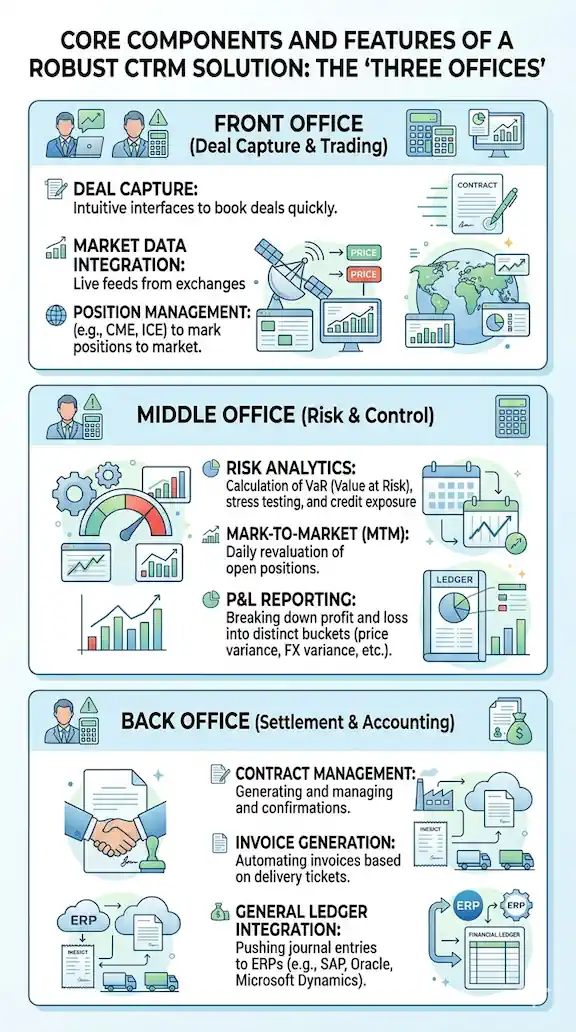
While financial trading systems focus on three offices, CTRM requires a fourth pillar "Physical Operations" to manage the actual movement of goods. Here are the four pillars of a robust solution.
Front Office
- Deal Capture: Intuitive screens to book complex trades (swaps, futures, options).
- Position Management: Real-time views of exposure by commodity, region, or delivery month.
- Pricing: Support for formula pricing, averaging, and escalators common in raw material trades.
Middle Office
- Risk Analytics: Calculation of Value at Risk (VaR), stress testing scenarios.
- Credit Risk: Monitoring counterparty exposure limits to prevent default losses.
- Mark-to-Market: Daily revaluation of open positions against exchange prices.
Back Office
- Invoicing: Automating invoices based on actual delivery quantities (vs. contracted).
- GL Integration: Seamless posting of journal entries to ERPs (SAP, Oracle).
- Tax & Compliance: Handling VAT, withholding tax, and regulatory reporting.
Physical Operations
- Movement: Tracking vessels, barges, rail cars, and pipeline injections.
- Inventory: Managing storage tanks, silos, and warehouses.
- Costs: Capturing demurrage, freight, and insurance costs for accurate landed cost calculation.
Who Uses CTRM Software?
Producers & Extractors
Mining companies and agribusinesses use CTRM to manage production output, optimize storage capacity, and hedge future sales prices to lock in revenue against market downturns.
Trading Houses
Physical traders (like Glencore or Trafigura) rely on CTRM to manage complex supply chains, arbitrage opportunities, and the logistical nightmare of moving goods globally.
Processors & Manufacturers
Food and bev companies or biofuel plants use CTRM to manage "crush spreads"—the margin between raw material input costs and finished product sales prices.
Utilities & Retailers
Power generators use ETRM to balance supply obligations with demand forecasting, ensuring they have enough power to serve customers without overpaying in the spot market.
Implementation Roadmap
Implementing a CTRM system is a significant digital transformation project. It typically takes 3 to 12 months depending on the complexity of your trades and the software architecture. A phased approach is critical to mitigating risk.
| Phase | Key Activities | Critical Success Factor |
|---|---|---|
| 1. Discovery | Map workflows, define requirements. | Don't automate bad processes. Standardize first. |
| 2. Configuration | Set up trade types, books, and hierarchies. | Stick to "out-of-the-box" features to lower TCO. |
| 3. Integration | Connect to ERP, exchanges, and market data. | Test APIs rigorously with high volume data. |
| 4. UAT & Go-Live | User Acceptance Testing & Training. | Parallel run: compare CTRM output with legacy system. |
How to Choose the Right Solution
Selection determines 80% of your project's success. Avoid the trap of focusing solely on UI aesthetics; look under the hood.
- Commodity Fit: Does the system handle the physical realities of your commodity (e.g., heating degree days for gas, or blending for grains)?
- Architecture: Is it Cloud-native (SaaS)? SaaS models offer lower upfront costs and automatic regulatory updates compared to on-premise legacy systems.
- Reporting: Can it generate the specific regulatory reports you need (e.g., EMIR, REMIT) without manual intervention?
The Independent Consultant Advantage
Vendors want to sell licenses. Big consulting firms want to inflate complexities and sell time. Independent consultants like Gerald Neher ensure the software actually fits your business. A consultant-led implementation can reduce time-to-value by 20-30% by preventing scope creep and managing vendor bias.